
How to Get Court Records
Jan Helmer, Clerk of the District Court, holds the Marion County District Court docket and files. The list of case types is long. It covers criminal, traffic, fish and game, civil, limited civil, small claims, domestic relations, child support, probate, juvenile, adoption, care and treatment, marriage-license, and court-payment matters. Municipal courts are separate. Each city keeps its own ordinance and city traffic records.
- Use Kansas Case Search to locate an eligible district case and any public document link.
- Use the public terminal at the Marion courthouse for eligible records that are not remotely available.
- Ask at the clerk counter or call 620-382-2104 to identify the file, confirm access, and obtain a current quote.
- Mail a request to 200 South Third Street, Suite 201, Marion, KS 66861, with the case number and exact document.
- Use the Kansas Judicial Branch KORA form for a precise written public-record request and state a delivery preference.
- Request a plain, certified, exemplified, transcript, or recording product as the actual need requires.
The Marion clerk accepts records requests by phone, in person, or in writing. Expect a response within three business days. Keep in mind the reply may be an estimate, an access decision, or an explanation of what comes next, not the documents themselves.
Choose the Marion Records Route
The portal, the terminal, the counter, and the Kansas Open Records Act process overlap. Each does a different job. Remote public case information fits the portal best. A courthouse terminal can show eligible documents the web never carries. For copies and authentication, the clerk is the office to ask. A written request gives you a clear description of what you asked for. It also records how it was delivered.
| Need | First route |
|---|---|
| Next hearing | Current Marion PDF, then clerk confirmation. |
| Case number or event | Kansas portal, then courthouse terminal. |
| Judgment or order | Portal document, terminal, or exact clerk request. |
| Authenticated copy | Clerk quote for certified or exemplified form. |
| Historical record | Clerk request with case number and date. |
| Recording | Eighth District electronic-recording form. |
Kansas eFlex serves authorized filing, not public inspection. The same goes for the drop box: it is a way to deliver filings, not a records request service.
Types of Court Records
A docket or events index points to activity in a case. The file holds the actual documents behind each entry. Ask for the item that answers your question. Requesting that the clerk build a new report only slows things down.
- Complaints, petitions, answers, motions, and other public pleadings.
- Journal entries, signed orders, judgments, dismissals, and appeal notices.
- Public docket sheets or chronological events indexes.
- Eligible criminal, civil, limited, small-claims, domestic, probate, and traffic documents.
- Transcripts or electronic recordings handled through the separate district procedure.
Exhibits, personal identifiers, juvenile material, adoption files, and sealed records may be restricted or simply unavailable remotely. An event listed on the docket does not guarantee its document can be opened online.
Pre-2019 Marion Files
On August 5, 2019, the Eighth Judicial District joined Kansas eCourt Track 1. Odyssey replaced FullCourt that day. Treat that date as a technology boundary. It does not promise every later paper is online. Nor was every earlier page scanned. State guidance ties online document availability to the eCourt start date, public status, conversion, and case category.
Marion prices microfilm prints in its own policy. That tells you the old format still matters for older court records. Ask for the public file or register entry by number and date. The clerk can then say where it sits. It may be electronic form, paper, microfilm, a converted file, or storage somewhere else.
What a Court Record Contains
What a court record contains depends on the case and the access rule. A docket sheet is a narrower ask than the signed judgment. A recording is different again, with its own form and approval process.
| Case identity | Number, caption, court, and case family. |
|---|---|
| Pleadings | Public petitions, complaints, answers, motions, and notices. |
| Events index | Chronological entries describing filed or scheduled activity. |
| Orders | Public journal entries, rulings, judgments, or dismissals. |
| Hearing data | Date, time, judge, courtroom, and setting where recorded. |
| Recording request | County, caption, case number, hearing details, reason, signature, and judicial decision fields. |
A calendar row is not the full case file. If you need the court's ruling, ask for the signed order. A hearing label alone will not tell you how the judge decided anything.
Requesting a GECO Recording
The Eighth District records proceedings electronically and employs no court reporters. Two transcriptionists based in Morris County serve the district. Transcript work takes an estimate and payment before preparation begins. A calendar note like "Recorded in GECO" is not an open audio link.
The official listening-request form asks for the county, case caption and number, date and time, judge, courtroom, reason, your signature, and the judge's decision. Submit it for listening access. For a written transcript, ask about the district transcription route. Ask for its current estimate too.
Certified Copies and Fees
A plain copy just reproduces the public record. A certified copy carries clerk authentication, which another agency, court, or process may require. An exemplified copy sits at a different authentication level. The clerk does not publish one complete current Marion schedule covering every certification, exemplification, search, recording, transcript, postage, or payment charge. Ask for a quote.
| Published item | Amount or rule |
|---|---|
| Plain copies | $1 minimum for up to four pages, then $0.25 per additional page. |
| Microfilm prints | $0.25 per page. |
| Attorney of record | One certified copy free; additional document copy is $1 under local policy. |
| Other certified or exemplified copies | Current amount not published; request clerk quote. |
| Transcript or recording | Estimate through the district process. |
Marion County Clerk of the District Court
200 South Third Street, Suite 201
Marion, KS 66861
620-382-2104
State whether each copy should be plain or certified before you pay. Certification is not just a better scan.
Write a Precise Marion Request
A strong request names Marion County District Court. It gives the case number when known, identifies the document or event, and includes a date or date range. Add the delivery method you want. Say whether you need a plain or certified copy. "The public journal entry entered on a stated date in a named case" works far better than "all records about every case."
Timing: K.S.A. 45-218 calls for action as soon as possible, ordinarily by the end of the third business day. That can be an estimate, delay explanation, or denial.
Hold back sensitive personal identifiers unless the clerk says they are necessary. Under K.S.A. 45-219, the clerk may charge permitted reproduction costs or request advance payment.
Kansas Access Law in Images
Kansas law favors openness, subject to stated exceptions, under K.S.A. 45-216, whose official text sets out that policy.
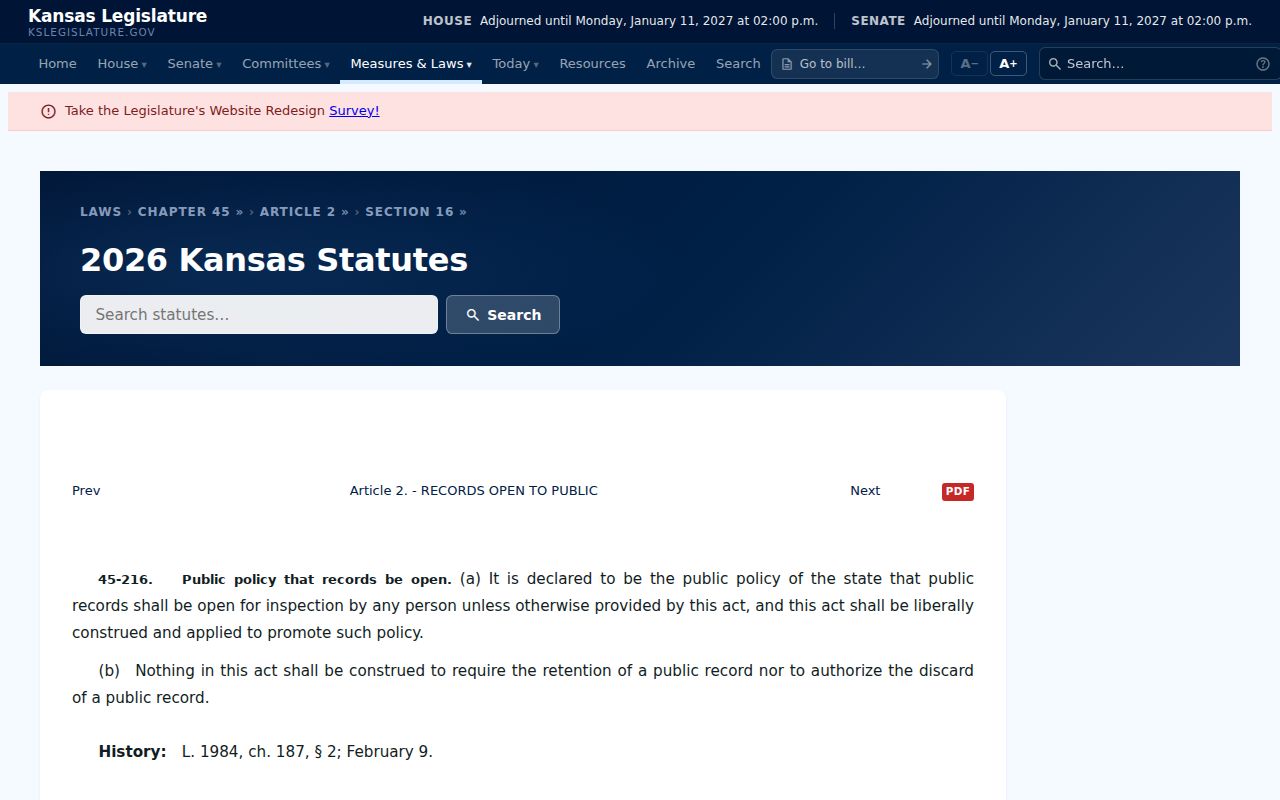
That policy still yields to court confidentiality rules for protected judicial files. For inspection rights and timely agency action, read K.S.A. 45-218.
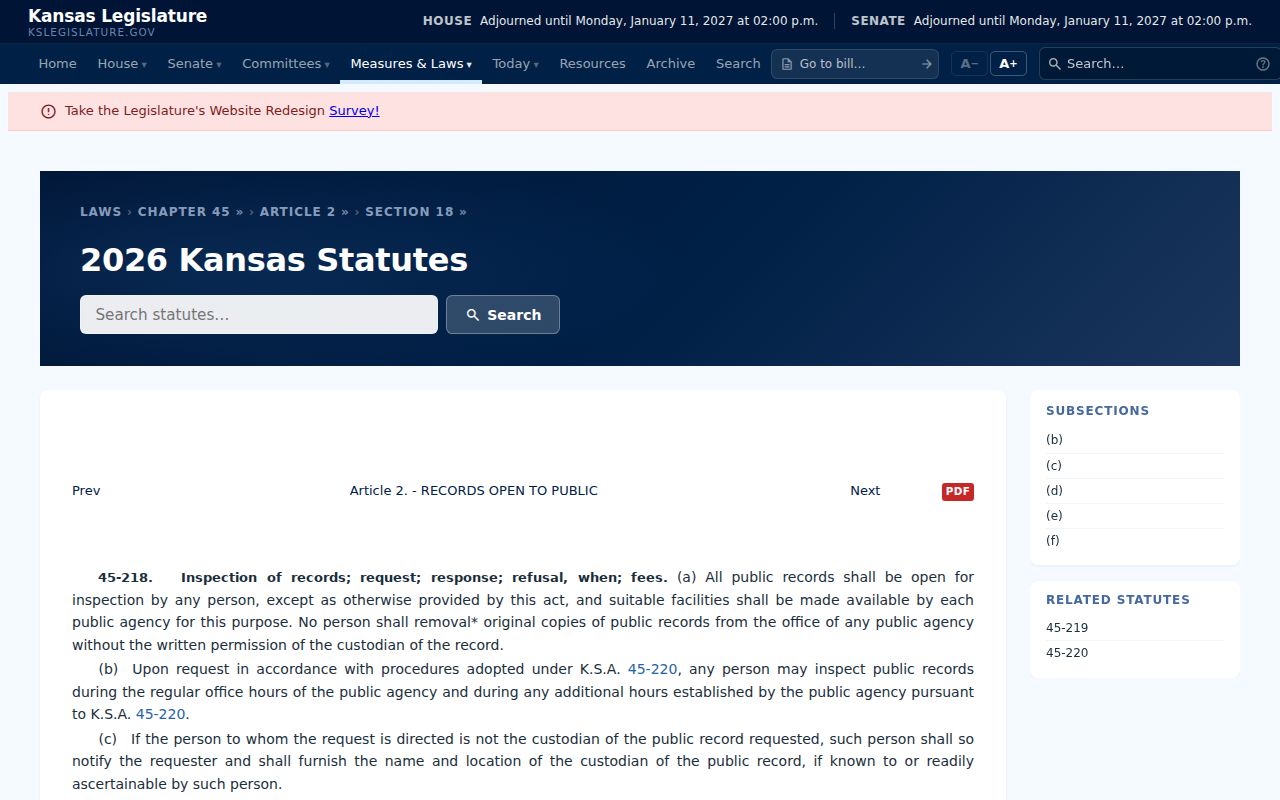
For Marion requests, the statute backs the local three-business-day response statement. It promises timely action, not instant production. Copy provisions appear in K.S.A. 45-219.
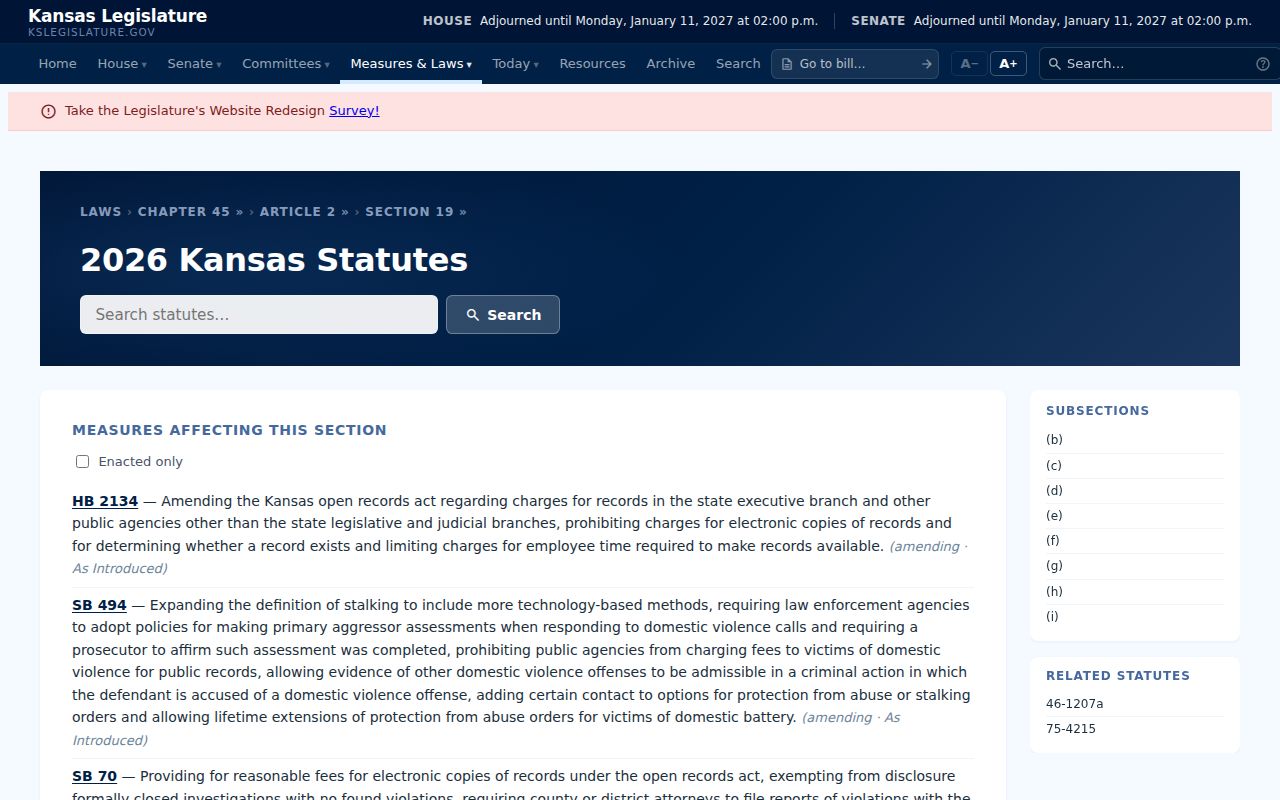
That section is why reproduction charges and advance payment can appear in a clerk request.
Public Access and Sealed Records
Kansas Supreme Court Rule 22 splits eligible public case information, events, and documents from nonpublic records. The statewide portal is convenient but incomplete. Courthouse terminals open another level of access, and the clerk weighs requests for specific documents case by case.
Key rules: K.S.A. 45-218 governs inspection and response; K.S.A. 45-219 addresses copies and costs; K.S.A. 45-221 preserves statutory exceptions. Rule 22 also controls court-record access.
Some Marion County files stay closed no matter how much you know. Juvenile, expunged, sealed, and adoption material can be withheld even when you supply the right case number. Two statutes control much of this: K.S.A. 38-2309 sets the rules for juvenile-offender access, while K.S.A. 21-6614 governs how expungement works. The practical move is to request the segregable public portion of the file and accept a lawful limit rather than trying to rebuild protected facts from other sources.
Marion Record Request Guardrails
The clerk will not build you a new database. Rule 22 asks for a particular case, event, date range, or document description. Narrow terms let the office split open material from protected material. If access is delayed or denied, save the written response. It should state the reason or give a production estimate.
Delivery methods matter too. The self-represented drop box is a convenience. It is not proof that your paper was accepted or entered that day. Under Marion policy, pleadings left at the front counter after 4 p.m. are processed the next business day. Anyone facing a deadline should use an authorized filing method and get confirmation. The same care goes to authentication: ask the court or agency what it wants. It may be a plain, certified, or exemplified copy. Decide that before you order. The policy does not publish every certification fee, postage cost, or payment method. A current quote from the clerk prevents an incomplete request. A portal PDF is not an authenticated copy.
Access can differ by route. A public terminal result may not match a remote portal result. Neither is broken. Rule 22 permits different access levels. What you can see depends on case category, public status, conversion, and the eCourt date. Jot down which route you checked. Then ask for the named public document. Do not assume a missing web link means the court record does not exist.
Historical searches need their own details. Give the clerk an approximate filing year. Add a party or estate name, the record family, and any known number. Marion's microfilm price shows that older material follows a reproduction workflow unlike a recent electronic case. The clerk, not a guessed online date range, can name the surviving public format and quote the right copy.